splunk.com ↗ · required email domain for this vendor's users
Headquartered in United StatesHeadquarters countrySourced only from this vendor's own published headquarters address (schema.org structured data on their site) — never guessed from domain TLD. Source ↗
Trust profileHow to read thisFive separate questions a buyer actually asks, each answered with its own evidence and a link to the source. There is deliberately no overall score: a single number invites comparison it cannot support, and would mostly reflect how much of Splunk we have managed to scan rather than anything about the vendor.
Not checked means we have not looked yet, and is never counted against a vendor. Limited means we did look, but found only one line of evidence — enough to report, not enough to corroborate.
checked 11 of 16 signals
Limited
Independently verified
Has anyone other than the vendor confirmed this?
checked 3 of 4
Nothing here has been confirmed by an independent third party yet.
No third-party certifications found
Profile not claimed by the vendor
Strong
Operating durability
Is this a real, durable business?
checked 3 of 4
How long this vendor has been operating, and who stands behind them.
Domain registered 2001 — 24 years ago
Headquarters: United States
Limited
Behaviour under stress
What do they do when something goes wrong?
checked 2 of 3
What their public record shows about handling vulnerabilities and outages.
20 published CVE(s) — a public disclosure record exists
No public status page found
Limited
Disclosure posture
Do they tell you the awkward things unprompted?
checked 2 of 3
How much this vendor volunteers before you have to ask.
Data coverage: 23/100What this measures (and doesn't)
Not a quality rating or endorsement — a measure of how much verified, disclosed data we actually have about this vendor. A low score usually means "we don't have much verified information yet," not "this is a bad vendor." Never used to sort or rank vendor lists.
The platform admin controls the formula's weights.
Data coverage profileHow to read thisThe same four components behind the data coverage score above, shaped instead of listed — a vendor strong on verification but thin on buyer feedback looks visibly different from one that's the other way around. Security and feedback plot at the neutral midpoint (50) when there's no data yet (no products tracked, no reviews), matching how the actual score itself treats missing data — not a guess either way.
IntegrationsUI-12 — integration graphDetected from this vendor's own published integration/partner pages by the enrichment loop — each entry links the exact page it was found on. Directional: "integrates with" is claimed by this vendor; "integrated by" is claimed by the other vendor's site. Coverage grows as the scan progresses.
Buyer reviewsUI-14 — verified-buyer reviewsWritten only by domain-verified buyers at other companies, attributed to their company domain (never their identity), and moderated. Buyer-sourced opinion, clearly separate from the neutral catalog facts above — and never an input to search or comparison ordering.
verified buyers only
No buyer reviews yet.
Reputation ratingUI-20 — anonymous ratingA single anonymous 5-star signal from buyers, resellers, and analysts who've engaged with this vendor — separate from the domain-attributed reviews above. No rater identity is ever shown, not even at company level.
anonymous
No ratings in this window yet.
External ratingsUI-22 — third-party ratingsAggregate rating and review count pulled directly from the source site's own published data — never the review text itself, which belongs to that site. Links go to the real page so you can read the actual reviews there.
Security & trust signalsAbout these signalsCertifications are keyword-matched from the vendor's own public pages (each claim links to its source — verify directly before relying on it). Security headers are checked live against the vendor's homepage, re-checked every 90 days. Both are independent, automated signals, not a vendor-submitted or audited claim, and are not blended into a single score.
9 of 9 technical checks completed — not a score, just coverage
CVE severity over timeUI-24 — CVE severity timelineEvery known CVE with a disclosure date and severity, plotted by when it was published — lets you see whether disclosures are trending toward more or less severe, not just a raw count. Same NVD-sourced, name-matched data as the list below.
Known CVEs (20)About this listSourced from the public NVD database, matched by vendor name. This is a name-based match, not exact version tracking — always check the linked NVD record for affected versions before drawing conclusions. “New” means published within the last 30 days. “Actively exploited” means CISA's Known Exploited Vulnerabilities (KEV) catalog confirms real-world exploitation, not just a theoretical severity score.
Cross-site scripting (XSS) vulnerability in the auto-complete feature in Splunk Enterprise before 6.0.4 allows remote authenticated users to inject arbitrary web script or HTML via a CSV file.
Cross-site scripting (XSS) vulnerability in Splunk Web in Splunk Enterprise 6.1.x before 6.1.3 allows remote attackers to inject arbitrary web script or HTML via the Referer HTTP header.
Directory traversal vulnerability in (1) Splunk Web or the (2) Splunkd HTTP Server in Splunk Enterprise 6.1.x before 6.1.3 allows remote authenticated users to read arbitrary files via a .. (dot dot) …
The "runshellscript echo.sh" script in Splunk before 5.0.5 allows remote authenticated users to execute arbitrary commands via a crafted string. NOTE: this issue was SPLIT from CVE-2013-6771 per ADT2…
Directory traversal vulnerability in the collect script in Splunk before 5.0.5 allows remote attackers to execute arbitrary commands via a .. (dot dot) in the file parameter. NOTE: this issue was SPL…
Cross-site scripting (XSS) vulnerability in Splunk Web in Splunk before 5.0.8 allows remote attackers to inject arbitrary web script or HTML via unspecified vectors.
Cross-site scripting (XSS) vulnerability in Splunk Web in Splunk 5.0.0 through 5.0.2 allows remote attackers to inject arbitrary web script or HTML via unspecified vectors.
Cross-site scripting (XSS) vulnerability in Splunk Web in Splunk before 5.0.6 allows remote attackers to inject arbitrary web script or HTML via unspecified vectors.
Cross-site scripting (XSS) vulnerability in Splunk Web in Splunk 4.3.0 through 4.3.5 allows remote attackers to inject arbitrary web script or HTML via unspecified vectors.
Cross-site scripting (XSS) vulnerability in Splunk Web in Splunk 4.2.x before 4.2.5 allows remote attackers to inject arbitrary web script or HTML via unspecified vectors, aka SPL-44614.
Splunk 4.2.5 and earlier, when a Free license is selected, enables potentially undesirable functionality within an environment that intentionally does not support authentication, which allows remote a…
Multiple directory traversal vulnerabilities in Splunk 4.x before 4.2.5 allow remote authenticated users to read arbitrary files via a .. (dot dot) in a URI to (1) Splunk Web or (2) the Splunkd HTTP S…
mappy.py in Splunk Web in Splunk 4.2.x before 4.2.5 does not properly restrict use of the mappy command to access Python classes, which allows remote authenticated administrators to execute arbitrary …
Splunk 4.0.0 through 4.1.4 allows remote attackers to conduct session hijacking attacks and obtain the splunkd session key via vectors related to the SPLUNKD_SESSION_KEY parameter.
The XML parser in Splunk 4.0.0 through 4.1.4 allows remote authenticated users to obtain sensitive information and gain privileges via an XML External Entity (XXE) attack to unknown vectors.
Splunk 4.0 through 4.0.10 and 4.1 through 4.1.1 allows remote authenticated users to obtain sensitive information via HTTP header injection, aka SPL-31066.
Multiple cross-site scripting (XSS) vulnerabilities in Splunk 4.0 through 4.0.10 and 4.1 through 4.1.1 allow remote attackers to inject arbitrary web script or HTML via (1) redirects, aka SPL-31067; (…
Multiple directory traversal vulnerabilities in Splunk 4.0 through 4.0.10 and 4.1 through 4.1.1 allow (1) remote attackers to read arbitrary files, aka SPL-31194; (2) remote authenticated users to mod…
Cross-site scripting (XSS) vulnerability in Splunk 4.0 through 4.1.2, when Internet Explorer is used, allows remote attackers to inject arbitrary web script or HTML via the HTTP Referer in a "404 Not …
Drawn from this vendor's own public materials and authored to keep category questionnaires balanced. Gaps reflect capabilities not emphasized in public materials, not rankings.
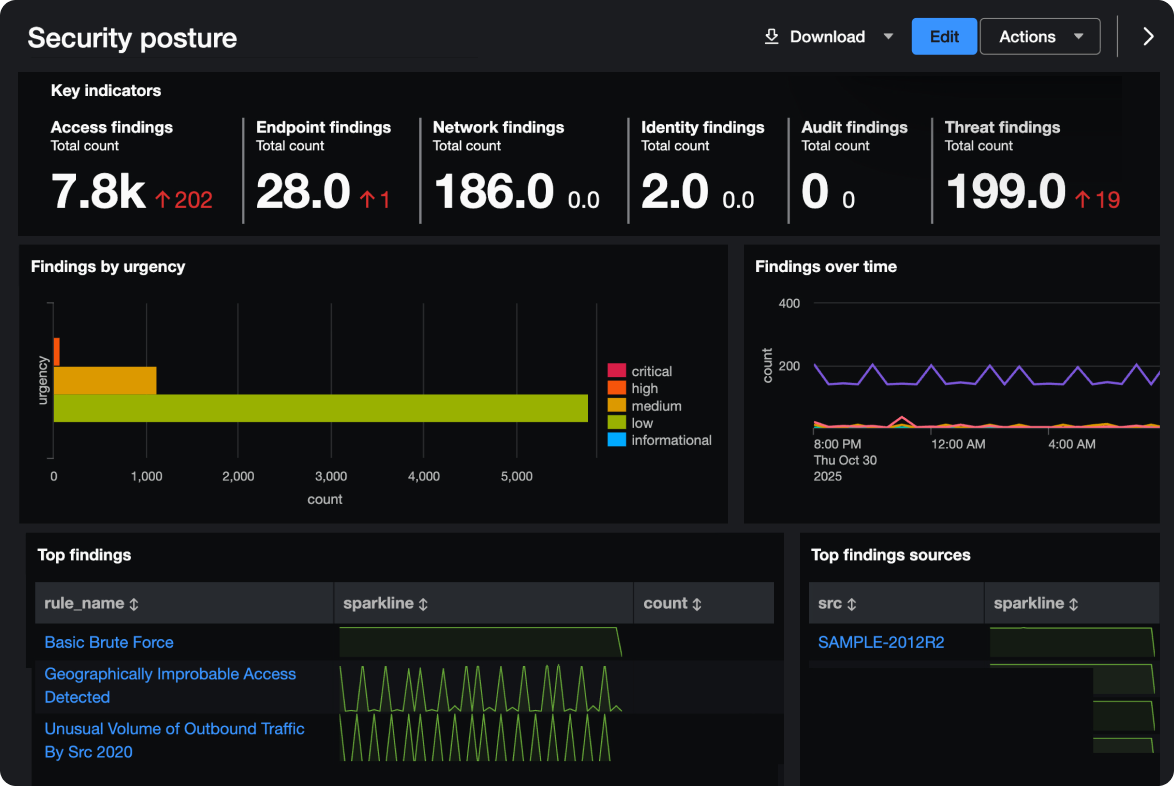
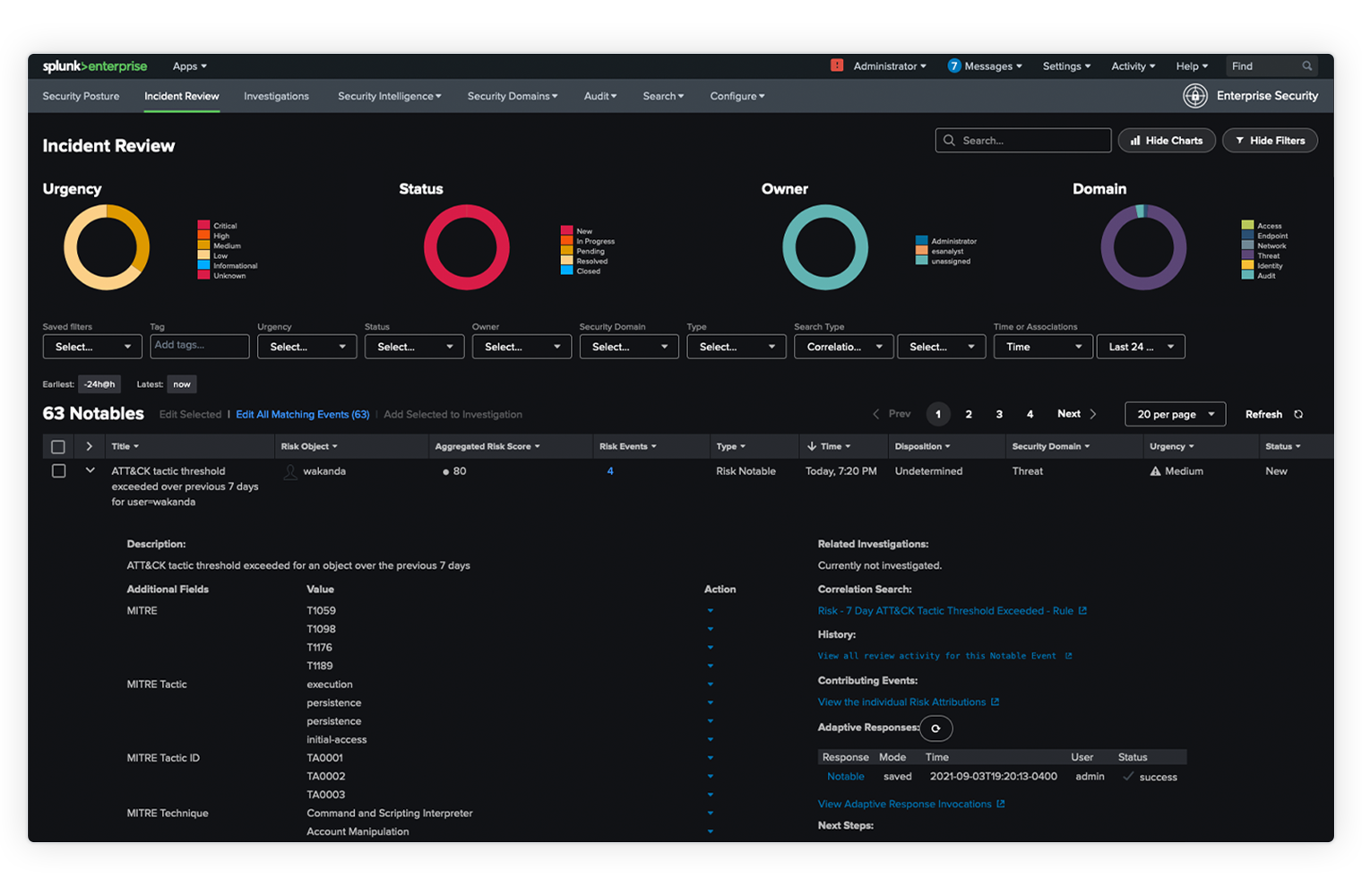
Strengths: Flexible, powerful SIEM (Enterprise Security) with a vast app ecosystem, the SPL search language, SOAR, and UBA.
Gaps:Data-volume pricing can be costly at scale, and the platform's power comes with operational complexity.
Products (7)
SIEM
5
Splunk Asset and Risk IntelligenceAsset/riskAI-generated from public sourcesAuto-generated by 0-Doubt from public vendor materials. Not verified by the vendor or an analyst. Check the freshness indicator.Lowest independence — unverified. A higher label means a more independent source — not a better product.How trust works →source ↗
Continuous asset discovery and compliance monitoring.
Splunk Attack AnalyzerAttack analysisAI-generated from public sourcesAuto-generated by 0-Doubt from public vendor materials. Not verified by the vendor or an analyst. Check the freshness indicator.Lowest independence — unverified. A higher label means a more independent source — not a better product.How trust works →source ↗
Detect and analyze credential phishing and malware threats.
Splunk Enterprise SecuritySIEMAI-generated from public sourcesAuto-generated by 0-Doubt from public vendor materials. Not verified by the vendor or an analyst. Check the freshness indicator.Lowest independence — unverified. A higher label means a more independent source — not a better product.How trust works →source ↗
Market-leading SIEM to detect, investigate, and respond to threats.
Splunk SecurityAI-generated from public sourcesAuto-generated by 0-Doubt from public vendor materials. Not verified by the vendor or an analyst. Check the freshness indicator.Lowest independence — unverified. A higher label means a more independent source — not a better product.How trust works →source ↗
Unified security operations platform for threat detection, investigation & response
Splunk User Behavior AnalyticsUEBAAI-generated from public sourcesAuto-generated by 0-Doubt from public vendor materials. Not verified by the vendor or an analyst. Check the freshness indicator.Lowest independence — unverified. A higher label means a more independent source — not a better product.How trust works →source ↗
User and entity behavior analytics against unknown threats.
Splunk SOARSOARAI-generated from public sourcesAuto-generated by 0-Doubt from public vendor materials. Not verified by the vendor or an analyst. Check the freshness indicator.Lowest independence — unverified. A higher label means a more independent source — not a better product.How trust works →source ↗
Automate repetitive security tasks and incident response.
User and Entity Behavior Analytics
1
Splunk User and Entity Behavior AnalyticsAI-generated from public sourcesAuto-generated by 0-Doubt from public vendor materials. Not verified by the vendor or an analyst. Check the freshness indicator.Lowest independence — unverified. A higher label means a more independent source — not a better product.How trust works →source ↗
ML-based UEBA detecting insider threats via behavioral anomaly detection and risk scoring.